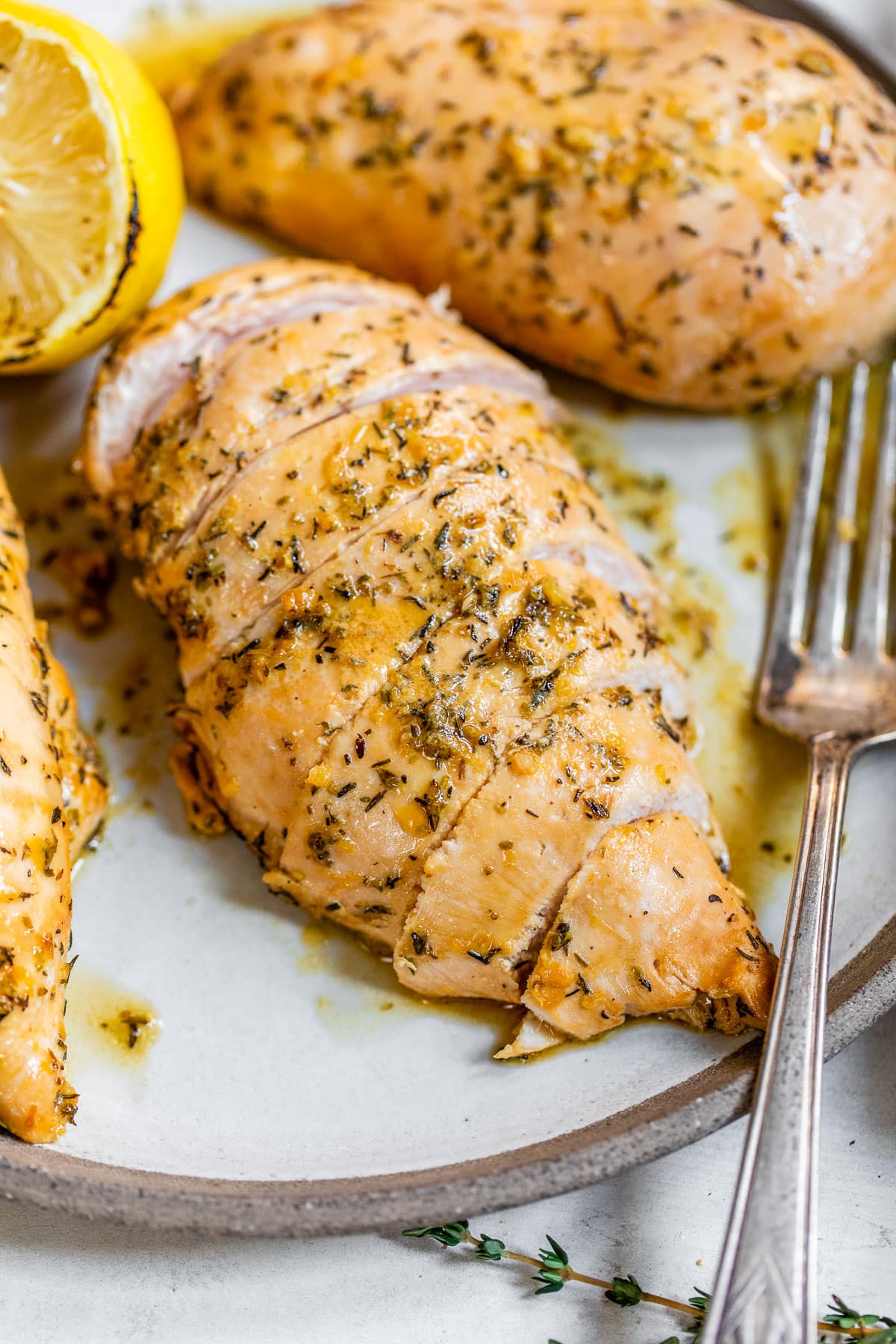
This quick combination of marinade ingredients not only will make your chicken actually taste like something (that "something" being savory, herby, and down-right delicious), it works double time to tenderize the chicken and make it juicy.
Just 15 minutes of marinating time can work wonders to juicify (<—my new favorite verb) and flavorize (<—my other new favorite verb) your chicken.
This chicken marinade recipe works for any cut of boneless chicken, be it chicken breasts, chicken thighs, or chicken tenders.
A marinade is a mixture of ingredients that generally contains an oil, acid, and a variety of spices and is used for soaking cuts of meat prior to cooking.
Marinades flavor the meat, make the meat more tender and moist, and can help prevent the meat from drying out as easily.
You can marinade meat for as little as 15 minutes or up to 24 hours, depending upon the marinade ingredients.
Below, you'll find the key components of a stellar chicken marinade that you can tweak to suit the recipes you'd like to use it in or what you have on hand.
I like to cook a big batch of marinaded chicken, then dice it up for salads, wraps, and grain bowls for lunches throughout the week.
Chicken cooked with this marinade is also tender and tasty enough to enjoy on its own, a rarity for many chicken recipes.
A chicken marinade should have four key components: fat, acid, seasoning, and time. You can play around with these in endless combinations.
Fat. Fat plays two roles in a marinade. It transfers flavors that are fat-soluble to the meat (meaning you won't be able to taste other ingredients as well without fat). Fat also helps to keep the meat moist. 99% of the time, I use olive oil. Vegetable oil is another excellent, neutral option.
Acid. Acid tenderizes the meat by breaking down its fibers. Citrus juices, vinegar, yogurt, and buttermilk are four excellent options. For today's recipe, I am using lemon juice. Lemon pairs beautifully with chicken and is easy to have on hand.
Seasoning. Here the possibilities are truly endless! Citrus zest, herbs, aromatics (like onion and garlic), and spices can all come into play. The one non-negotiable is SALT. I use either kosher salt or, for even more complexity, soy sauce and a dash of Worcestershire.
Time. MARINATING LONGER IS NOT BETTER! The ideal amount of time to marinate chicken is 5 to 6 hours, but even 15 minutes makes a difference. See below for more.
How Long to Marinate Chicken
Marinating chicken for too long can actually cause it to become tough, negating the original benefits of the marinade.
Typically, I find that marinating chicken between 5 to 6 hours is ideal for both texture and taste.
I don’t recommend keeping chicken in a marinade with citrus juice or vinegar for more than 6 hours, as its texture declines from there. After 12 hours, the meat may even start to break down.
Chicken can rest in a buttermilk/yogurt marinade for up to 24 hours. So, this is the best choice for those who want an overnight chicken marinade.
The Best Easy Chicken Marinade
Today's chicken marinade is a simple go-to that works well for a variety of recipes and everyday enjoyment.
Marinating chicken is healthy AND delish. It's a perfect way to increase the appetite appeal of your wholesome meals.
The Ingredients
Olive Oil. My choice of fat for the marinade. You only need a little bit (this chicken marinade is not unhealthy in the slightest) and olive oil offers healthy fats, antioxidants, and anti-inflammatory properties.
Lemon Juiceand Zest. This tenderizes the chicken and gives it bright citrus notes. I also use the zest to make the most of the lemon.
Herbs. You can use almost any dried or fresh herbs for this chicken marinade. I'm a sucker for an Italian chicken marinade, so my most-used herbs are oregano and thyme or simple Italian seasoning.
Seasoning. Soy sauce and Worcestershire sauce season the meat to help the others flavors shine and they add a more complex umami component compared to kosher salt alone. Fresh garlic is my other must-have chicken marinade seasoning. It's a dream with the lemon and herbs.
Tip!
For inspiration for how to play around with chicken marinades, check out these recipes:
Sheet Pan Tandoori Chicken. Found in The Well Plated Cookbook, this one-pan meal uses yogurt and is safe to prep as an overnight chicken marinade. It's so tasty, I cooked it live on Good Morning America.
Fajita Chicken Kebabs. Lime juice, chili powder, cumin, and jalapeno create the spectacular flavor for this chicken kebab marinade.
Orange Chicken. Uses a sweet and bright marinade of orange juice, honey, and soy sauce.
Ready to IMMEDIATELY improve your cooking? Marinate your chicken!
With this easy, effective chicken marinade recipe, healthy baked and grilled chicken will become something you look forward to enjoying for a dinner, instead of a bland burden.
As always, if you try this recipe, I'd love to hear what you think! Your comments make my day and are so helpful for others too.
If making chicken breasts, place them on a cutting board, cover with plastic wrap, and with a meat mallet or rolling pin, pound into an even thickness. (If using tenders or thighs, you can skip the pounding).
With a fork, poke holes all over the chicken (this will allow the marinade to absorb).
In a large ziptop bag, combine the garlic, lemon zest and juice, olive oil, soy sauce, Worcestershire sauce, thyme, oregano, salt, and pepper.
Add the chicken. Seal the bag, removing as much excess air as possible.
"Squish" the bag to coat the chicken, then place the bag on a plate or inside a shallow baking dish to guard against leaks.
Marinate the chicken at room temperature for 15 to 30 minutes (the longer the better), or refrigerate for up to 12 hours (I find about 5 to 6 hours is ideal—since this is a small amount of lemon juice, you can push to 24 hours if absolutely necessary). Do not let marinade for longer, or the meat will start to break down. Let the chicken stand at room temperature for 15 minutes prior to cooking.
When ready to cook: Preheat your grill to medium high (425 to 450 degrees F) or preheat your oven to 425 degrees F. Remove the chicken from the marinade, shaking off any excess.
To grill: cook chicken over high heat until charred in spots and the internal temperature reaches 160 to 165 degrees F on an instant read thermometer, flipping halfway through, about 8 to 12 minutes total for breasts or thighs or 4 to 8 minutes for tenders. Do not overcook!
To bake: Arrange the chicken in a single layer in a foil- or parchment-lined baking dish large enough to hold it comfortably without the chicken touching. Bake the chicken until it reaches 160 F to 165 degrees F on an instant read thermometer inserted at the thickest part. Don't overcook! For breasts you will need about 14 to 16 minutes (for small/medium breasts that are about 6 to 7 ounces), 16 to 20 minutes (for medium/large breasts that are 8 to 10 ounces), or 20 to 25 minutes (for larger breasts). Bake thighs or tenders for 15 to 20 minutes.
Remove the chicken to a plate and cover. Let rest for at least 5 minutes. Serve!
Video
Notes
*You can also use this recipe for bone-in chicken pieces, including drumsticks. For drumsticks, instead of poking the chicken with a fork, cut a few slashes with a knife. Bone-in chicken will need a longer cooking time.
TO STORE: Refrigerate chicken in an airtight storage container for up to 3 days.
TO REHEAT: Rewarm leftovers on a baking sheet in the oven at 350 degrees F.
TO FREEZE: Freeze chicken in an airtight freezer-safe storage container for up to 3 months. Let thaw overnight in the refrigerator before reheating.


No comments:
Post a Comment