Ideal Home |
- The ultimate cavity wall insulation guide
- Green bathroom ideas to invigorate your space
- How to measure for a sofa- 5 experts share their top tips
- Best soup maker 2022: for smooth soups and chunky broths
- Shopping Edit – 11 lovely storage baskets for carrying your clutter
- Kitchen tile ideas to add style and personality to your walls
- Step inside this refurbed 1930s home with a calm but cool colour palette
- 10 best sofas: affordable sofas that are big on style
- Thatched roof insurance explained
| The ultimate cavity wall insulation guide Posted: 27 Jan 2022 12:00 AM PST There are many benefits to having cavity wall insulation (CWI) in your home. According to the Energy Saving Trust, uninsulated walls account for almost a third of the heat lost from a home. That means fitting cavity wall insulation is a great chance to slash your energy bills and save energy at home. It's also one of the most cost-effective and long-lasting upgrades you can make. Modern masonry homes are built using cavity walls, which typically feature an inner blockwork wall, a cavity and an outer wall of brick or rendered blockwork. The gap in between the layers is filled with energy-saving insulation to Building Regulations standards. Older houses might have cavity walls but no insulation, resulting in a colder property and not as energy efficient as it could be. Thankfully, existing cavity walls can be filled with insulation without needing to be rebuilt. ‘Most of a home's energy is used in space heating and if you don't have good structural fabric all you do is lose heat through walls,’ says Simon Storer, Chief Executive at the Insulation Manufacturers Association. ‘Most properties built after 1920 have a cavity wall – and most after 1990 will have insulation in it. Houses built before 1920 usually have a single skin brick wall, meaning there's no cavity to be filled, so these types of homes can only be treated with external or internal wall insulation.’ What are the benefits of cavity wall insulation? Image credit: Future plc/David Giles Well-insulated external walls help to create an efficient building envelope. This means less heat escapes from inside your home. Your central heating system won't have to work as hard to achieve comfortable temperatures, saving energy and money on utility bills, and reducing your carbon footprint. With fuel costs on the rise, now is a good time to invest in cavity wall insulation. You might not see the same pound-for-pound reduction in energy bills as you once would have, but you will be using less energy – so you'll be protecting yourself against upcoming energy price hikes. Upgrading insulation is the foundation for creating a more energy efficient house. This is known as a fabric first approach. ‘It's very important to make the insulation in your home as good as it can be,’ says Simon Storer. ‘Invest in making the building fabric efficient before spending lots of money on high tech solutions like solar panels and heat pumps.’ Consider engaging an independent energy assessor to help you develop a short and long-term plan for improving your whole property's energy efficiency. ‘You'll get the best benefits if cavity wall insulation is part of a wider plan for the whole property to reach the best energy efficiency possible,’ says Nigel Donohue, CEO at the Insulation Assurance Authority. What types of cavity wall insulation are there?These are the best materials for insulating your home… 1. Blown mineral wool insulationMineral wool can be blown into a property's cavity walls to form an energy efficient insulating layer. It's cost-effective and offers good performance. The cavities need to be clean and free from obstruction, otherwise the insulation may get caught and prevent a full fill. 2. Polystyrene bead insulationThis method involves blowing small balls of expanding polystyrene insulation (EPS) into existing cavity walls through small holes. Beads are quick to install, high performing and don't absorb moisture. ‘One advantage of beads is that a long nozzle can be used that shoots the insulation into hard-to-reach areas,’ says Ed Andrews, Commercial Director at cavity wall insulation supplier InstaGroup. 3. Injected foam insulationPolyurethane (PU) foam can be pumped into a cavity wall, where it will solidify and form a thick, water-repellent insulating barrier with impressive thermal performance. This option isn't as commonplace, and the Insulation Assurance Authority (IAA) doesn't cover it under its guarantee scheme. There are situations where it makes sense, however, for instance if a property is in a flood risk area or has uneven cavities 4. Cavity insulation for new wallsSheets of insulation are fitted straight into the cavity as new brick and block walls are built. Semi-rigid batts or slabs of mineral wool or rigid PIR boards are the most popular options, available in different thicknesses to achieve the desired performance level. Partial fill solutions leave a 25mm-50mm gap between the cavity and external wall to reduce the chance of moisture tracking into the home. Who supplies cavity wall insulation? Image credit: Future plc/Colin Poole Retrofitting cavity wall insulation is not a DIY job; and badly fitted CWI by a cowboy builder could cost you a serious amount of money to fix. It's important to employ a qualified installer using an approved insulating system. Look for a company that's a member of the Cavity Insulation Guarantee Agency (CIGA) or National Insulation Association (NIA). Check out their websites for lists of registered installers in your region. Going through a professional body means you'll benefit from someone else checking that the installer meets the membership standards. Make sure your installation is covered with a 25-year CIGA guarantee, which will protect you if you experience problems with your insulation. For new homes and extensions, your contractor will typically source insulation for you through their preferred builder's merchant. Tips for installing cavity wall insulation1. Work out your wall typeIt can be tricky to tell if your home has cavity walls, but there are clues to look for. Cavity wall bricks tend to be laid in an even pattern with only the long edge exposed, whereas solid walls often have a mixed pattern of long and short brick ends. The thickness of the wall is another indicator – cavity walls are normally over 260mm thick, whereas single skin walls are narrower. More modern homes may already be insulated. Having a professional look inside the wall (see point 4) may be the only way to confirm what you're working with. 2. Ensure the walls are in good repairWalls need to be in a good condition to have insulation fitted, otherwise all the benefits will be lost. Defects like cracked render, missing pointing, leaky gutters or damp patches inside can all impact on efficiency and may lead to damage if left unresolved. Get these fixed first before upgrading the insulation – some CWI installers will do this work for you. 3. Are you in a flood risk or coastal area?If you're in a flood risk zone or somewhere exposed to driving rain, such as by the sea, then your home might not be suitable for cavity wall insulation. A reputable professional will be able to let you know what insulation method is best for your home. 4. Check inside the cavityA good installer should survey your walls before any work is done. They will assess the overall condition and look inside the cavity using a borescope to check for issues. For instance, any rubble or existing material would need to be cleaned out before new insulation is fitted. This process will establish which type of insulation is going to be best for your home. 5. Fit the insulationYour specialist installer will drill holes into the outside of the wall and feed the insulation into the cavity, taking care to ensure every nook and cranny is filled. Once complete, the holes are filled up. The installation should only take a couple of hours, so there's minimal disruption to your daily life. If required, any extra ventilation should now be installed. What maintenance is required for cavity wall insulation? Image credit: Future plc/James French CWI is a fit-and-forget option, so you won't need to maintain the insulation itself. Improving ventilation and staying on top of general property upkeep will ensure your energy efficient home continues to perform as expected. Installing cavity wall insulation will help keep heat inside your home and reduce energy usage. But warm air carries more moisture, which can lead to damp and mould, so extra ventilation might need to be fitted as part of the upgrade. Some installers offer this as part of their service. Simple lifestyle changes can help manage humidity, too, such as opening windows when cooking, drying clothes outside where possible etc. ‘With this level of insulation, you need appropriate ventilation,’ says Nigel Donohue. ‘And having cavity wall insulation doesn't mean that you can just turn your heating off. Problems with condensation and mould can happen when a home isn't heated.’ Faults in your home's structural fabric could expose your cavity walls to excess moisture and lead to problems with damp. So, keep on top of regular home maintenance. Your checklist will be similar to the pre-installation assessment: look for wall cracks, broken window seals, leaking gutters etc, and make sure vents aren't blocked. If your property shows symptoms of damp that you think are caused by cavity wall insulation, this is where that professional-backed guarantee becomes important. Contact the company that did the job, arrange for them to assess your home and complete any remedial work needed. If they don't help or they've gone bust, you'll have your CIGA guarantee to fall back on. Install dehumidifiers where needed. How does cavity wall insulation affect my EPC rating?An Energy Performance Certificate (EPC) provides information about a property's energy use. The EPC shows how much heating, hot water and lighting is likely to cost per year, as well as probable carbon dioxide emissions. Every home built, sold or rented must have an EPC, which rates the house from band A (most efficient) through to G (inefficient). The certificate also indicates potential improvements that could be done to your home, including how much the work might cost and the estimated future savings on energy bills. Adding insulation is a common EPC-recommended solution, as a more energy efficient envelope equals lower heating demand. Upgrading your cavity walls with insulation will have a positive impact on your EPC rating, and could even raise an uninsulated house up by an entire band. But the government's stated target is for existing homes to achieve a C rating by 2035; and CWI isn't likely to achieve this on its own. A whole house approach to improving a property's energy performance – also taking in elements such as floor and roof insulation, windows, heating systems etc – is the best way to maximise its potential efficiency. Do new builds come with cavity wall insulation as standard? Image credit: Future plc/Polly Eltes Every newly built house – whether it's constructed with cavity walls or another method – must meet or exceed the Building Regulations for energy efficiency under Approved Document L. ‘The Regulations are all being updated in 2022, making them more demanding. In addition, they will set targets for expected carbon emissions and overall energy demand from homes,’ says Matthew Evans, Head of Technical GB at Kingspan Insulation. ‘To achieve these, the external walls on most new properties will need to be insulated to a higher standard than the minimum U-value targets.’ Because cavity walling is a site-based trade, the efficiency of the finished home relies on good practice during construction. So it's crucial to find experienced, trustworthy builders and trades with proven track records of delivering what they've promised. There are two main approaches to insulating a new cavity wall: partial fill and full fill. Both offer a choice of rigid foam and mineral wool-based insulations. The key difference is that partial fill cavity wall insulation retains an air gap (usually 50mm) between the insulation and the outer brick or block leaf. The gap provides better protection against water ingress, but it's not suitable for every project and some builders prefer full fill because there's less chance of things falling into the space. Should I add cavity wall insulation to my extension? And which is best? Image credit: Future plc/Douglas Gibb Most extensions are built with cavity walling. Under the Building Regulations, they must be insulated to modern standards. Rigid foam boards and mineral wool batts are your main options, and the best choice will depend on your project goals. If you want best performance in the thinnest wall profile, for instance, rigid foam can deliver that – albeit at a slightly higher price. You could technically build a new, thermally efficient extension onto an existing house and leave it at that. You'll be missing a trick, though, especially if you're creating a lovely new open-plan space that flows into the old house, like a kitchen-diner. This would leave you with a mostly leaky house that doesn't maximise the performance benefits of the new addition. So, minimise disruption and take the opportunity to upgrade thermal efficiency elsewhere in the house while you've got the builders on site – whether that's with retrofit cavity wall insulation, loft insulation, floor insulation or a combination of all three. The post The ultimate cavity wall insulation guide appeared first on Ideal Home. |
| Green bathroom ideas to invigorate your space Posted: 26 Jan 2022 11:00 PM PST Finding your perfect green bathroom idea is all about the shade you love and makes you happy. Think about whether there is natural light available and how the light changes throughout the day before making your choice. Think about the mood you want to create with a green bathroom colour scheme – calm and relaxed or vibrant and energised? And the style of course – contemporary, classic or traditional? 'Shades of green are back in demand in interiors.' Says Kamila Chalfin, Brand Manager at Tile Giant. 'Green is known to promote renewal, balance, refreshment and peace. It can create a calming influence and reduce stress, so it's ideal for a bathroom. Green bathroom ideasGreen was hugely popular in 2021 and looks set to continue into 2022, and it's a great colour for bathrooms. Similar to blue and in the same colour family but a bit less obvious for a bathroom. Green is the colour that most reminds us of nature and is considered the most restful hue – making it ideal for rejuvenating spaces, such as bathrooms. Here are a few ideas to inspire your green bathroom idea. 1. Welcome tropical green wallpaper Image credit: Future PLC/ Georgia Burns People worry about using bathroom wallpaper ideas but there is no reason it can't be used, in the right circumstances. If the room is large and has good ventilation, it will be fine but to be extra safe, choose a vinyl wallpaper that is durable, washable and is a good choice for areas of high humidity. Alternatively you could use decorators varnish over your chosen wallpaper. This leaf design is a lovely choice for a bathroom, giving a jungle retreat feel. 2. Paint the panelling Image credit: Future PLC/ David Giles Create interest in a plain bathroom with wall panelling up to dado height, then paint it in a subtle pale sage colour. You could even add a narrow shelf on top of the panelling for accessories or picture frames as they have here. The ornate gilt mirror adds a vintage, luxurious look. 3. Choose deep green tones image credit: Popham Design If green is your favourite colour use a striking saturated jewel green to create a bold bathroom scheme. Pair colour-coordinated tiles that clash in pattern to zone the different areas within the space, and prevent the tone from looking flat and overwhelming. 4. Surround yourself with spa-like marble green Image credit: Topps Tiles Be bold with your bathroom tile idea for an immersive feeling. Deep emerald green is a cocooning shade, so is a wonderful colour for a bathroom that is mainly used in the evening. It's a dramatic shade, particularly when it's a natural stone like this marble with the distinctive veining and shading in the stone. A black basin and stand adds to the drama with brass fittings for a luxurious touch. Buy now: Emerale marble tile, £82.94 m2, Topps Tiles 5. Introduce a contrasting colour pop Image credit: @thistimeincolour; Concrete basin from Kast These rectangular tiles have been laid vertically to give the illusion of height in this bathroom under the eaves. There is plenty of daylight from the skylight, so the room can take a deeper colour, but use white grout to lift the scheme and to give the tiles definition. The paint colour on the walls has been matched, as has the small pendant light. Then the wall-hung basin is a pop of colour which sits perfectly on the jade green tiles. 6. Dip into perfect peppermint Image credit: Future PLC/ David Giles Such a pretty shade, these mint coloured Metro tiles have been used on all the walls making it easier to look after and keep clean. A large mirror makes the room look bigger than it is and a full length window brings in lots of natural light, the perfect bathroom for mornings. A wood effect cabinet and shelf adds warmth and contrast. 7. Paint the bath Image credit: Future PLC To make a statement in the bathroom with green without overwhelming the walls, why not paint the bath? This wonderful shade of sage is a serene colour and is restful to the eye. Teaming with soft aqua and blues tones helps to create a wonderfully tonal scheme without it feeling too ‘green’. The exposed brick wall and touches of woodwork help to add to the natural appeal of using earthy green tones. 8. Define the shape Image credit: BC Designs Painting one wall in an olive shade – a big trend this year – really accentuates the shape of this bathroom in a loft. There is plenty of height and light, so the bathroom feels spacious. The green wall really brings out the colour of the grey stone floor too. 9. All over colour Image credit: Stone & Ceramic Warehouse Really brighten up your mornings with this rejuvenating apple green shade. These rectangular tiles come in plain and with a dot effect so mix them up for an interesting finish. They also have a rippled surface for texture and interest. Buy now: Salerno Apple tiles, £49.33 m2, Stone & Ceramic Warehouse 10. Create a green focal point Image credit: Blinds2go A simple way to dip your toe into green is by introducing accents through window treatments and accessories. You could introduce forest green into a plain bathroom with a striking patterned blind such as this one by designer Emma Bridgewater, and bring nature in. Team it with wooden shelves, a wooden mirror and a vintage-style stool for a country-look Buy now: Emma Bridgewater Choices Figs Green roller blind, £124.84 for 120cm x 120 cm, Blinds2go Is green a good colour for a bathroom?'Green sits comfortably in any interior scheme because of its relationship with the natural environment and our longing to bring the outdoors inside' explains Ruth Mottershead, Creative Director of Little Greene. 'We feel soothed by green and its neutral base – it is neither too warm, nor too cool and works beautifully paired with other greens, as we see regularly in the gardens and greenery that surrounds us. It can help to create a cocooning feel and sense of escapism.’ What colour goes with green in a bathroom?'For a calm, sophisticated neutral to work in a green scheme, we tend to recommend warm, soft whites with either slight yellow or red undertones.' Says Anna Hill, Director of paint company, Fenwick & Tilbrook. 'Our most popular warm white is Oyster which, teamed with a green is gorgeous!’ ‘For a more playful room scheme, pairing green with pink can be either soft and subtle (sage greens with plaster warm pinks) or really bold fresh and fun depending on whether you choose muted, paler tones or full-on saturated paint colours. Our personal favourite pairing is mid-tone olive ‘Natterjack’ used with plaster pink ‘Vintage Peony’.' What colours go with dark green in a bathroom?'Lovers of dark green are typically down to earth and are in touch with nature' says Victoria Yardley, founder of Victory Colours. 'Dark greens work beautifully in a bathroom and it's easy to create a stunning, tranquil space perfect for a bit of 'me time'. ‘ ‘Dark green works wonderfully with whites and blush pink combinations, to create a clean and refreshing space. In turn all greens work well with warm coppers and golden fixtures for an opulent feel. Or add crisp white tiles and wood details, to create a natural zen bathroom to calm the senses. Make sure to add plenty of green foliage too to finish the look.’ The post Green bathroom ideas to invigorate your space appeared first on Ideal Home. |
| How to measure for a sofa- 5 experts share their top tips Posted: 26 Jan 2022 09:16 AM PST It’s an invest piece that’s important to get right, so knowing how to measure for a sofa is essential to avoid that classic ‘Ross from Friends’ moment…PIVOT! A new sofa can totally transform a room and with so many stylish designs on the market, it can be a bit of minefield to whittle down what the best sofa for your home is, before you’ve even thought about the size! Not only does your sofa have to fit your desired space perfectly, but it’s also got to get through the door- and possibly up stairs and round tight corners first. We’ve probably all fallen fail to online shopping and bought something that has turned up far bigger or smaller than we expected. While this can make for an amusing anecdote, it can also cause a lot of stress and cost us some hard-earned money when it comes to pieces of furniture. How to measure for a sofaCharlie Marshall, Founder of Loaf says, ‘Having your new sofa delivered should be fuss-free and relaxed, so we always suggest measuring up and checking dimensions of your room before placing any orders. That way, our delivery crews can ensure that sofas will be able to fit in through doors, around tight hallways and up or down stairs.’ Kellie Wyles, Head of Upholstery and Brand at DFS says, ‘Measuring for your sofa is an important step in the sofa decision making process. It's not a case of simply getting the tape measure out, but also about considering what works best for a space, how it will look visually and work logistically.’ Luckily, if you follow our handy guide, ordering your new sofa should go without a hitch, and you’ll be sat down with your feet up in no time. 1. Think about how you use the room Image credit: Future Plc/Simon Whitmore First things first, you need to choose a sofa that is right for you, so it helps to know how you currently use the space, or how you plan to use the space. There are plenty of living room sofa ideas out there, so this should help to streamline your choices. ‘Start by thinking about what your living room is going to be used for. Some people have separate living rooms from the rest of the house and a lot of us have knock throughs where it's off the kitchen/diner, but whatever size of space it's important to understand whether it's a social place or if it's a place for watching TV, or both, says Charlie. ‘Symmetry in a social or formal space will look great and the balance between sofas facing each other, or even a sofa and two armchairs, will be visually appealing. Introduce a large footstool or coffee table in the centre and some ambient lighting for an intimate feel. If it's a family room then it's likely that the sofa will be a main feature, and this could even be a large corner or chaise style. Create balance with a coffee table or a storage footstool in front of the sofa and add a large armchair or love seat to one side. The armchair or love seat will create a visually even weight to the room which will keep it feeling balanced. The trick is to not group too much furniture in one part or at one side of the room.’ Kellie advises to make sure you’ll be giving your new sofa the space it deserves. ‘Your first step should be to look at the room where you plan to put your sofa and consider what's needed for the space. Do you need a sofa that will fit into a snug corner or are you looking for a statement piece for the middle of an open plan room? Perhaps you would prefer a big, comfy, corner option for movie nights with the whole family! Once you've established this you can start to search for a sofa style that works with your space.’ 2. Scope out the space Image credit: DFS Buy now: Swoon Rene 4 seater sofa in in teal velvet, from £999, DFS Next you need to get a feel for the space and take into consideration how much of the room will be left once the sofa is in. ‘It's always helpful to walk around the space where the sofa will be to check you can move around it comfortably,’ says Kellie. ‘This will help you ensure that you'll still be able to open windows and doors when the sofa is in situ and move past any coffee or side tables. Similarly, take note of any nearby shelves or radiators to ensure the sofa height isn't a problem.’ Charlies goes on to suggest, ‘Always keep in mind how people will be coming in and out of the room and arrange the furniture accordingly as traffic flow is key. You don't want any knocks or bumps and you don't want any awkward weaving through the room. Aim to keep paths fuss-free and clear! Generally, you want lots of space! I'd say that walkways should be a minimum of 900mm and if it's less than this then you'll feel it.  Image credit: Future Plc/Maxwell Attenborough Patricia Gibbons from the Design Team at Sofa.com adds, ‘The scale of your sofa is important. Too big and it can feel like it engulfs the whole room, too small you'll be fighting over the best seat in the house. Finding that sweet spot is key. Smaller rooms benefit from selecting sofas with slimmer proportions and sleek, clean silhouettes. Choose a model with elegant, tapered legs which raise the frame from the floor to give the illusion of more floor space. These larger scale pieces feel more statement and create an anchor to design around without overpowering a large living room. They also help zone, effectively acting as a room divider.’ 3. Measure, measure and measure again! Image credit: Snug Buy now: The Rebel 3 seater sofa in warm grey, £1299, SNUG So now comes the measuring part, which is imperative to ensuring you choose the right size sofa. All of our expert offer slightly different approaches of how to measure for a sofa, but they all agree, it’s one you don’t want to get wrong. Dani Burroughs, Head of Product at Snug advises, ‘To measure for your new sofa, it's always a good idea to note the dimensions of the existing furniture. You'll want to make sure your new sofa fits in the space without overcrowding – or underwhelming.’  Image credit: Sofa.com Buy now: Medium Bluebell corner sofa in Prussian blue cotton matt velvet, £4570, Sofa.com ‘Another way to get a real sense of the size is to choose a style you like and map out its dimensions on the floor by laying out cardboard or taping an outline with masking tape. Play around with the different options: try sizing up or down until you find the perfect sofa that fits your home and style,’ continues Dani. Suzy McMahon, Buying Director at Sofology, suggests, ‘Make sure you measure your room accurately and, if you have an existing sofa, use that as a benchmark to understand any differing dimensions of a new model. A good tip in an empty room is to lay down newspapers to help you visualise the footprint the sofa will use. Don't forget that, when considering sizing, you'll need to allow for leg room and space to move around the sofa.’ Patricia adds, ‘Think about the amount of floor space you have and take a rough measurement of the maximum length and width the room can accommodate. It's often difficult to visualise so if it helps, lay down a silhouette in newspaper or tape markers on the floor. You want to leave enough room to comfortably walk around the sofa and for other pieces of furniture.’ 4. Consider access Image credit: Future Plc/Joanna Henderson So you know that your chosen sofa will fit once inside the room, but how about getting it there? ‘Don't just think about what the sofa will look like in the space, also think about how you'll get it there in the first place,’ says Kellie. ‘There are lots of ways to work around tricky access, from sofas with bolt-on arms that can be fixed once your sofas are in place to smaller, modular pieces’ Suzy adds, ‘Delivery is a key stage in the process of buying a new sofa, so make sure hallways and doors are wide enough to accommodate your sofa. To maximise space without compromising comfort, consider a corner sofa or chaise. Not only are they great for relaxing, their length serves as an integrated footstool that saves additional space in the room. Selecting a style with hidden storage can also help to make the most of a small room, negating the need for additional bulky furniture in the area.’ ‘Avoid unnecessary stress with a sofa that comes in a box and is ready to assemble in minutes without the need for DIY skills, heavy lifting or tools, ‘ adds Dani. All of Snugs sofas and sofa beds are delivered in a box, fit into awkward spaces and up winding staircases and are fully modular and re-configurable. 5. Get the layout of your room right Image credit: Loaf Buy now: Smithy loveseat in Potter Pink clever linen, from £1445, Loaf The next thing to do is ensure your new sofa sits correctly within your space. Charlie advises, ‘If it's a large open plan area and you're expecting plenty of traffic, you could look at zoning the space with open shelving. By creating a slight separation, you can keep the flow of the space without losing the cosy feel of the living room. Consider also using your sofa style to your advantage. Chaise and corner designs are an effective way to zone a space and offer walkways which will help the flow of the room.’ Suzy adds, ‘Positioning the sofa against a wall will help to keep the room open, especially in a smaller space. A sofa's proportions are particularly important in compact living. Opting for a petite sofa with a tall back and narrow arms will make the piece appear larger than it is, whereas choosing a corner sofa with a low back can help make a room feel bigger and the sofa less imposing.’ ‘Neutral sofas work well where space is limited, and can be kept up to date with cushions and throws in bold patterns and colours’.  Image credit: Sofology Buy now: Cartwright 2 seater sofa in Altara Putty all over, £1799, Sofology With all these easy-to-follow tips from the sofa gurus themselves, it should make the sofa measuring process quick and simple, so you can feel confident that your sofa will fit your space perfectly. How do you check if a sofa will fit?Suzy says, ‘Selecting the perfect sofa is a very personal choice and will balance many factors, including practicality, comfort, style and budget. For smaller spaces, the initial practical considerations are essential but fairly straightforward; think about the space you have in your room and how many you would like to seat.’ Next make sure your chosen sofa will fit through doorways! This is often something that is often overlooked, so the first thing to do is note down the ‘packaged’ dimensions of your chosen sofa- the width (W), height (H) and depth (D). Also be sure to measure the narrowest point of your stairs, if the sofa needs to go to another floor. If this measurement is wider than the packaged height of your sofa, then it should fit. Don't forget that if you need to lift a sofa over a bannister, the distance between the bannister and the ceiling must be greater than the packaged depth of your sofa at the narrowest height. How to do you measure a sofa for a room?Get your tape measure out and double check every measurement you take! Kellie advises, ‘It's critically important to note the width (the measurement across the back of the sofa), the depth (the measurement from the back of the sofa to the front) and the height (the measurement from the floor to the top of the back of the sofa). Take particular note of the depth of the sofa if you're buying for a smaller room, as the depth of the seat rarely changes from the larger to smaller size sofas. One top tip for making sure that your sofa will fit in your space is to cut out the shape of your sofa from newspaper in the correct dimensions and place it on the floor in the room to get a sense of the area it will take up.’ Don’t assume all sofa sizes are the same, a three seater at one brand, might be quite different in size to another brand, so make sure you measure up any new sofa you plan on buying. Charlie says, ‘Because every Loaf sofa is handmade, the size can vary by approximately 3cm. So if your measurements come up a little tight we recommend sticking on the safe (smaller) side’ What is the standard size of sofa?Sofas come in lots of different sizes, from little loveseats, to huge corner sofas, so there isn’t really a standard size as such. That said, an average 2 seater sofa is approximately W175cm x H98cm x D95cm; an average 3 seater is W210cm x H98cm x D95cm and an average 4 seater sofa is around W240cm x H98 x D95cm. But this is differ slightly from brand to brand, so be sure you are fully clued up on how to measure for a sofa before making a purchase.
The post How to measure for a sofa- 5 experts share their top tips appeared first on Ideal Home. |
| Best soup maker 2022: for smooth soups and chunky broths Posted: 26 Jan 2022 07:25 AM PST Soups season is far from over, and the best soup makers will turn out perfectly creamy concoctions to make your winter lunching a lot easier. A lot of the best soup makers can turn raw ingredients into steaming hot soups in just over 10 minutes, and with models from Ninja, Drew & Cole, Morphy Richards, and Salter to choose from, there is no shortage of options. Each and every one of the six best soup makers in our guide have been reviewed hands-on by our expert testing team. We made all sorts of soups, from leek and potato to curried root vegetable, and took into account how easy the soup makers were to clean and to store. A couple of the best soup makers in our guide are two-in-one alternatives to the best blenders, with heating elements to make hot and spicy sauces, and regular modes for icy milkshakes. While they can’t go through the dishwasher because of the in-built heating element, they often come with settings for self-cleaning that will reach even the trickiest corners of the jug to remove any leftovers. Then, all you’ll need to do is rinse out the sudsy residue. Other things we loved in the best soup makers included clear designs to watch your soup as it cooks and blends, and modes to keep your soup warm after it’s cooked, so you’ll be able to enjoy a bowl as soon as you’re ready. What is the best soup maker?
We tested five of the best soup makers on the market, and the one that came out on top was the Ninja Foodi HB150UK Blender and Soup Maker. We were seriously wowed by the soup it produced, which was smooth and creamy, and it offers a delay start mode. If you're looking for a soup maker that’s got a clear cooking container, we love the Morphy Richards Clarity Soup Maker. It's got a clear tritan jug and heats very fast. 1. Ninja Foodi HB150UK Blender and Soup MakerBest soup maker overall
Capacity: 1.7 litres cold and 1.4 litres hot Reasons to buy: • Saute setting Reasons to avoid: • Only makes 3 portions of soup We put this soup maker to the test to see how it measures up against blenders, and it’s one of the best we’ve tried. The jug is made of sturdy glass that can withstand heat even for prolonged periods of time. The display shows a countdown timer, and the blades can even chop and saute your onion and garlic before adding the rest of your ingredients. The chunky mode was particularly good for fresh vegetables, and we were really impressed by the smoothness of our butternut squash soup, especially when we used it to blend nuts and halved carrots from raw. Soup makers can make a great pasta sauce, or a topping for your curry, but it’s nice to have the option of a model with a fully dedicated sauce mode. The self-clean setting is very effective, and if you’re wondering, it also functions very well as a blender for making milkshakes and smoothies. Ideal Home rated 5 out of 5 stars Read our full Ninja Foodi Blender and Soup Maker review 2. Drew and Cole Soup Chef ProBest soup maker for delay starts
Capacity: 1.6 litres Reasons to buy: • Saute setting Reasons to avoid: • It's quite large If you like the sound of coming home to a fresh cooked soup that you prepared before you left home, the Drew & Cole Soup Chef Pro is the best soup maker for you. It's easy to delay the start by 30-minute intervals up to 12 hours, and the smooth cooking mode takes just 19 minutes. There's also a smooth+ setting for seriously velvety soups, but even on the regular setting, we had zero issues with lumps or grainy ingredients. Everything was perfectly silky and cooked just how we like it. Another major perk is the saute setting, which is on the handle of the soup maker. You can sear your onions or garlic using this mode before adding stock and starting the blending setting. For the quality of the design, we also think it comes at a great price. Ideal Home rated 5 out of 5 stars 3. Morphy Richards Clarity Soup MakerBest soup maker with a clear jug
Capacity: 1.6 litres Reasons to buy: • Watch your soup as it cooks Reasons to avoid: • The working capacity isn't the largest The Morphy Richards Clarity Soup Maker warns you that ingredients could stick to the bottom when cooking, but we had no issues with this when making our soups in it. Straight out of the box, it's very easy to assemble. We were surprised to find that the jug is not glass, but felt like plastic. In fact, it is tritan, which is a very durable but lightweight material free from BPA. The smooth soup setting is only 22 minutes, which means you can set your soup up to cook and finish your bowl within the same lunch break. Cooking was very speedy, and the ingredients were simmering within five minutes of us turning it on. The controls at the top are straightforward to use, and there is one for smooth, chunky, and smoothie, and clean. The quality of the blending was great, and it also has a keep warm function that kept our soup perfect for drinking after it had finished blending. Ideal Home rated 5 out of 5 stars 4. Lakeland Touchscreen Soup and Smoothie MakerBest high-end soup maker
Capacity: 1.75-2 litres Reasons to buy: • Transparent tritan jug Reasons to avoid: • An expensive option that won’t fit under counters The Lakeland Touchscreen Soup & Smoothie Maker is by far the most premium-looking option we tested. It has a price tag to match, though, so if you drink a lot of soup then it will be a great investment. With a modern design and a blender-like jug, it has modes for smooth and chunky soups as well as sauces and even iced drinks. We really enjoyed the control panel, which made the process very easy, and the timer also helped to know when to add any extras. We were able to add cream to our tomato soup once the blending started thanks to a removable lid insert. If you want an extra smooth finish you can also just blend without heating once your soup has finished. The auto-clean function was also very effective. Ideal Home rated 4.5 out of 5 stars 5. Judge Soup MakerBest soup maker for extra functions
Capacity: 1.2 litres Reasons to buy: • Heats very fast Reasons to avoid: • Smaller capacity than some The Judge Soup Maker has a capacity of 1.7 litres, but if you're making soup it will only take up to 1.2 litres. We found that it heated up very fast, and because the jug is plastic and see-through it's possible to watch your soup as it cooks. We enjoyed the powerful blending modes which left us with a very smooth soup, and because it's got a classic blender-style design you can also use the Judge Soup Maker to make chilled drinks. The removable cap allows you to add ingredients while it's cooking, but we did find that the lid was sometimes tricky to lock into place. Ideal Home rated 4 out of 5 stars 6. Salter Electric Homemade Healthy Soup MakerBest value soup maker
Capacity: 1.3 to 1.6 litres Reasons to buy: • Budget-friendly option Reasons to avoid: • Some ingredients burnt to the bottom Salter's soup maker is the most budget-friendly option in our guide, and it's a trusted choice to make either chunky or smooth soups. You are warned that ingredients can burn to the bottom before use, and a good way to fix this is to add some oil to prevent sticking, but we still found that there was a little burning after our soup was finished. There are two soup modes: smooth, chunky, and one for blending or self-cleaning. The self-clean mode is very effective at removing residue from the blending blade. We also liked using the blend setting to add an extra blitz for soups we wanted a little smoother. Ideal Home rated 4 out of 5 stars How we tested the best soup makers Making broccoli and stilton soup in the Lakeland touchscreen soup maker Soup makers can be used to make all types of different soups, including chunky, smooth, and even gazpacho. When testing the best soup makers we cooked a variety of recipes to make sure they were all up to the task of making even tricky soups. Some classics, like butternut squash or leek and potato, will blend very easily into velvety smooth soups, whereas others like pea soup or broccoli and stilton, will need to be very well cooked and blended to achieve the consistency you're after.  Making butternut squash soup in the Judge soup maker We also made a lot of tomato soup using tomatoes and red peppers to see if the skin would pose a challenge to the cooking and blending, and while we used the same recipes, it was amazing to see the slight (or sometimes not-so-slight) differences that arose between different soup makers upon testing. The post Best soup maker 2022: for smooth soups and chunky broths appeared first on Ideal Home. |
| Shopping Edit – 11 lovely storage baskets for carrying your clutter Posted: 26 Jan 2022 07:00 AM PST Searching for a simple way to hide your clutter that doesn’t involve DIYing or drilling holes into your walls? Enter: the extremely versatile storage basket. For hiding anything from the abundance of kids toys that are usually sprawled across your living room rug, to your bedroom cushions whilst you sleep – and even your blanket collection that’s by now in double digits, surely? We’re here with the very best – and most stylish – storage baskets that you’ll want to style in your home. Similar to that of a laundry basket, although the storage baskets on our list are super versatile. We’ve listed lidded options and open storage baskets, plus wall-mountable storage baskets to save floor space and even storage baskets that can slide under furniture. One of the many living room storage ideas that we love, there’s nothing stopping you from using a storage basket anywhere from inside your bedroom to in your hallway, bathroom, nursery or even in a kitchen to hold shopping bags or cleaning products. In short: there’s plenty to choose from, whether your home is modern, minimalist, a little boho or perhaps you’re searching for a storage basket for your nursery? It’s all here. The best stylish storage baskets for your home1. Dunelm Monochrome Paper Storage Basket Image credit: Dunelm This highly-rated storage basket from Dunelm is as stylish as it is practical. Offering a sizeable amount of space inside to hide everything from shoes to throws and toys, it’s crafted by hand from paper materials. This makes it eco-friendly, and with handles, it’s easy to move from your living room to your bedroom, bathroom or elsewhere. Thanks to its monochrome print, it will also prove to be a striking addition to your home. It’s also a total bargain. Buy now: Monochrome Paper Storage Basket, £15, Dunelm 2. H&M Cotton twill storage basket Image credit: H&M A storage basket for the kids’ bedroom, with a cute rabbit design – complete with floppy ears, too – this storage basket is handy for hiding their abundance of toys. It has handles for easy dragging (and pulling to the floor for their toys to tumble out), plus it comes in a smaller size if you want to buy the matching set. It has a drawstring closure to keep their things tucked away safely, and so that wandering eyes won’t be able to see what’s inside, whether that be toys or laundry. It’s made from 100% cotton, meaning that you need only wipe it with a damp cloth to get it clean. There’s another similar storage basket available, in brown which instead of a rabbit, is a bear. Pick their favourite. Buy now: Cotton Twill Storage Basket, £12.99, H&M 3. Sea Team Storage Baskets
Another eco-friendly option, these storage baskets are made from a mix of jute and cotton linen, and they are foldable for ease of use. Yes, once you are done with them you can tuck them away down the side of furniture or inside a drawer. They’re great for housing smaller items, such as trinkets, LEGO, socks, cables, dummies, plus they’re super sturdy so there’s no need to worry about weight. With handles for easy access, they could be displayed on open shelving or atop a chest of drawers. Safe to say they’re aesthetically pleasing and versatile since you can use them anywhere from your kitchen to your living room, nursery or even in your utility room. Buy now: Sea Team Storage Baskets, £12.99, Amazon 4. Dunelm Wicker Black Storage Basket Image credit: Dunelm This open basket is great for storing blankets, books, cushions and towels, but admittedly not so great for toys and smaller items. We love its open look since it will make the basket look a little less clunky on your floor. For an airy, modern look, this storage basket is made from wicker and finished in a sleek black colour. Complete with upright handles, we say to perch it beside a sofa or bed or push it into a corner for the best look. Buy now: Wicker Black Storage Basket, £15, Dunelm 5. Habitat 102 Litre Water Hyacinth Laundry Basket Image credit: Habitat Not just for holding your dirty clothes and towels, this lidded basket is also great for storing anything from clean bedding to toys, all in plain sight. Thanks to its lid, your guests won’t ever know what’s inside, and it’s woven in sustainable water hyacinth to make it aesthetically pleasing. Not only that, but it will definitely add a warm vibe to any room in your home. It’s pretty practical, too, with a polyester liner that’s removable for your convenience. Buy now: Habitat 102 Litre Water Hyacinth Laundry Basket, £45, Argos 6. H&M Large lidded storage basket Image credit: H&M Check out this lidded option from H&M, which is undoubtedly handy for storing away seasonal clothes underneath your bed, or at the bottom of your wardrobe. With a zip closure to keep dust away, this bag also has handles for easy reaching. Just because you’re stashing these baskets away doesn’t mean they don’t need to be stylish, right? They’re made from ecru cotton and recycled cotton, and they come in a range of sizes to suit your space, no matter its size. Buy now: Large lidded storage basket, £19.99, H&M 7. H&M Canvas wall storage basket Image credit: H&M A storage basket with a difference, this one won’t take up any valuable floor space that you treasure. Instead, you can mount it to a wall to hold anything from jewellery to accessories, kids books or toys and even toiletries. These super versatile baskets can be used pretty much anywhere, and we love them stacked atop one another – to make use of otherwise empty wall space. With a sturdy mango wood frame, these canvas baskets are brilliant. They also come in black. Buy now: Canvas wall storage basket, £17.99, H&M 8. Dunelm Butterscotch Rush Basket Image credit: Dunelm Decorative and handmade, this natural basket will definitely add a subtle pop of colour to your rooms. It’s large enough to store shoes, cushions and blankets, and we think that it’s too pretty to hide. With this in mind, you might want to perch it beside an important piece of furniture, such as a sofa, to make it stand out. It’s super strong, so rest assured it will provide a place to hide your things for years and years. Buy now: Butterscotch Rush Basket, £25, Dunelm 9. La Redoute Set of 2 Bustta Baskets in Water Hyacinth Image credit: La Redoute These baskets come as a set of two, one of which is larger than the other. They are lidded and you could use them for hiding toiletries in your bathroom, for separating and holding the kids’ toys, or for hiding bits and bobs in your bedroom or hallway. Made from natural water hyacinth, they boast a white stripe at their base to make them a little different to your classic woven basket. These on-trend baskets will prove themselves to be a handy addition to your home, whether you style them together or place one in one room, and the other in a different area of your home. Buy now: Set of 2 Bustta Baskets in Water Hyacinth, £45, La Redoute 10. Matalan Dark Grey Small Felt Basket Image credit: Matalan An ideal addition to a teenage bedroom, this felt basket is simple yet practical. With wooden handles so that they can carry their laundry from their room to the utility, or for easy dragging around their room to throw random things inside. It also folds with ease once empty. Definitely one for a teenage boys bedroom, plus it’s a steal. Buy now: Dark Grey Small Felt Basket, £6, Matalan 11. DOKEHOM Thickened Laundry Basket Image credit: DOKEHOM Labelled storage baskets? We’re totally here for it. Mrs Hinch and Stacey Solomon would be proud! These Amazon storage baskets are labelled ‘Etc.’ ‘Stuff’ and ‘Things’, to add a little something to your average plain storage basket. They’re perfect for popping on open shelving or inside a wardrobe, and for holding and housing towels, toiletries, toys and even socks and tights. With handles for easy grabbing, they are even made from strong jute with a steel frame around the top edge. Buy now: DOKEHOM Thickened Laundry Basket, £11.99, Amazon Browse more storage baskets…Still on the search for the perfect storage basket for your space? You can shop for more stylish options below, from our favourite retailers.
The post Shopping Edit – 11 lovely storage baskets for carrying your clutter appeared first on Ideal Home. |
| Kitchen tile ideas to add style and personality to your walls Posted: 26 Jan 2022 06:00 AM PST When designing your kitchen there are so many surfaces and materials to consider. Make a practical and design-led choice by using kitchen tile ideas to give your walls the wow factor. From patterned or coloured options, to shaped or simplistic, the right tile and laying pattern can make all the difference in creating your dream scheme. The perfect material no matter your kitchen ideas, tiles are an opportunity to experiment and have some fun. ‘The kitchen provides the perfect blank canvas for expressing your true sense of style,’ says Amanda Telford, Marketing at CTD Tiles. ‘Whether you are looking for a tile that evokes the texture and characteristics of natural stone, or hoping to go more decorative with a geometric tile, most tiles are suitable for installation in kitchens.’ From choosing a quirky shape to playing around with colour blocking, these kitchen tile ideas will get your imagination flowing. Kitchen tile ideasWhichever style of these kitchen tile ideas you take on board, do note that you may need to use a sealant. ‘All tiles, aside from ceramic and porcelain, should be sealed with a recommended sealant before installation,’ says Damla Turgut, founder of Otto Tiles & Design. ‘This protects the tiles, which are naturally porous, from everyday dirt, grime and stains. If you don't want to do this, then opt for a ceramic or porcelain tile which can be easily cleaned with a wet sponge or cloth.’ 1. Combine tonal shades Image credit: Future PLC/Davide Lovatti ‘Neutrals, greys and creamy whites are always popular for kitchen colour schemes on walls,’ notes Damla from Otto Tiles. ‘Lighter tones inherently look fresh and clean.’ Instead of choosing just one of these warm neutrals, consider combining several tonal shades instead. By limiting yourself to a strict colour palette, the overall effect will feel cohesive and natural. Opt for tiles with a naturalistic finish for a truly warm and relaxed effect. 2. Use vinyl tiles Image credit: Future PLC Tiled splashbacks are always effective but whether for time or money, it’s not always possible. Instead, cheat your way into a new splashback with kitchen tile decals. Instead of classic tiles, get the effect using a roll of tile-effect sticky-backed vinyl film. Edge the vinyl with a painted wooden batten for a neat finish. 3. Create pattern with colour blocking Image credit: Future PLC/Mark Scott You don’t have to use patterned tiles to achieve a patterned finish. Give brick tiles a twist by arranging them in horizontal stripes of colours for a fun kitchen splashback. Play with widths of the coloured tiles on the floor to see what effect looks the best. If you’re using more than one colour, break them up with white to give the shades room to breathe. 4. Introduce character with exposed brick Image credit: Future PLC/David Giles If you want enduring beauty and individual character, look no further than exposed brick. A classic option for feature walls, this material can work equally as well all over, including on splashbacks – although they will need to be protected with a sealant. You don’t even have to have original brick walls in place, or commit to building new walls. Brick slips – tiles manufactured to look like bricks – achieve the style with much less fuss and cost. 5. Tile your cupboards Image credit: Blakes Kitchens When considering kitchen tile ideas for your walls, think outside of the box. Or, well, inside. Elevate glazed kitchen cupboards by tiling the insides. This can be done in the same tile as the rest of the wall to create a seamless look. Alternatively, only tile this area for a statement focal point. 6. Link with an unexpected surface Image credit: CTD Tiles Create a cool and contemporary look with your kitchen tile ideas with some unexpected co-ordination. ‘For those looking to create a designer look,’ advises Amanda from CTD Tiles, ‘consider positioning your tiles in a unique format for a striking focal point’ Tiling the sides of a breakfast bar or kitchen island ideas in the same laying pattern but different shade to your walls will result in a unique and stylish effect. 7. Get bold with colour Image credit: Pluck Kitchens ‘In kitchens we've noticed recently that it's all about statement colour and a lot of people are using their kitchen splashback ideas as focal points,’ says Amanda from CTD Tiles. ‘We've seen everything from bold and bright hues to more natural tones that deliver an earthy aesthetic. There really is no rulebook to what colour you should go for and there is no right or wrong answer, however we recommend opting for tiles in a striking colour such as blue, green or even vibrant red as its adds contrast to interiors.’ Choose a contrasting shades to your cabinetry for some serious colour-blocking cool points. 8. Play with colour, shape and pattern Image credit: Future PLC/Katie Lee More sometimes really can be more. Instead of choosing shape, colour or pattern, why not have fun with all three? A shapely tile, in a bright colour, with a pattern. To make the look seem cohesive, choose a pattern which links each tile together, rather than creating a patchwork effect. 9. Add interest to metro tiles Image credit: Verona Group Metro kitchen tile ideas are a cool contemporary go-to. Add extra interest to yours by mixing up the material. Choose a marble, or marble effect, stone cute into metro tile rectangular shapes. You’ll still achieve the chic, minimalist effect of classic metros, but will an added extra something. 10. Add a hint of colour and pattern Image credit: Future PLC/ Polly Wreford For a subtle approach to adding colour to a kitchen tile ideas, form a splashback using a row of single tiles. This sophisticated kitchen colour scheme is uplifted by the addition of muted coloured encaustic tiles, placed along the wall behind the sink. The use of colour and pattern is not imposing, merely enhancing – especially given the tones are echoed throughout the space via lighting and crockery choices. 11. Break up block colour with classic white tiles Image credit: Future PLC/ Lizzie Orme Add interest to a shaker kitchen by wrapping tiles around the room. Use classic white tiles to act as a neutral between two strong colour choices, one for the cabinetry and the other for the walls. As is the case in this statement kitchen the white tiles wrapped around the room breaks up the punchy green units and the delicious pink painted walls. A neutral coloured tile gives you the freedom to change the wall colour as the mood takes you. Tiling half the wall this way is practical and will protect your walls from any kitchen splashes. 12. Add an extra dimension with hexagon tiles Image credit: Future PLC/ David Giles You don’t need colour to make a statement. This effortless white kitchen idea shows how filling the space with different textures, materials and shapes will add interest – without the need for colour. Kitchen wall tiles are perfect for doing this. This honeycomb tile blends seamlessly into the white washed walls to create a sleek contemporary look. 13. Mismatch shapes and patterns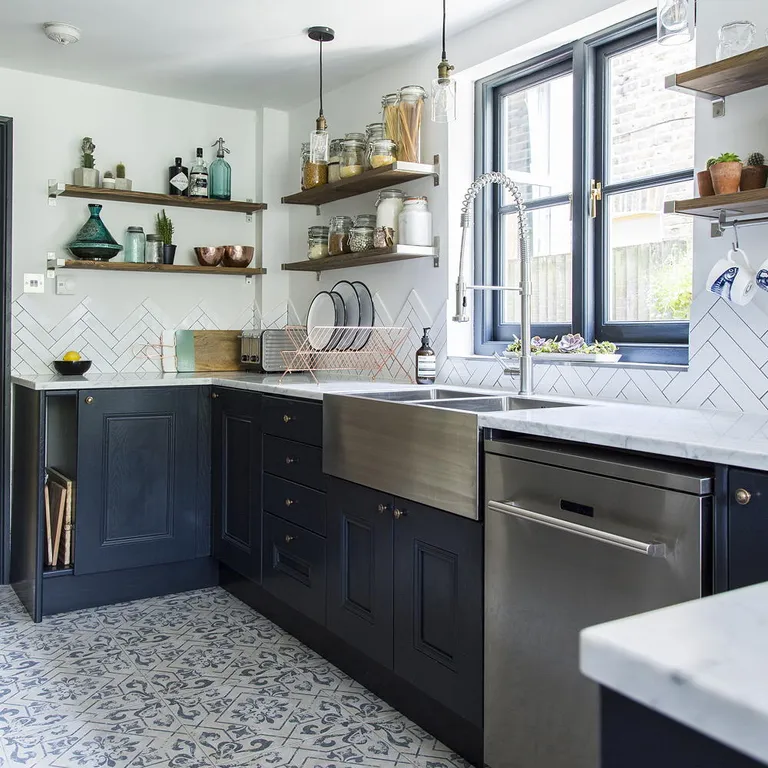 Image credit: Future PLC/ Lizzie Orme If you’re looking at kitchen floor tile ideas along with the walls, don’t be afraid to mismatch the shape, colour and even finish. On the floor it can be tempting to opt for a simple design, however you can use this space to make a statement with a patterned tile. Then keep the walls in a plain tile to invert the typical way to tiling the two surfaces. 14. Coordinate colour on different surfaces Image credit: Ca’ Pietra, Atlas tiles Use patterned tiles in a bold coloured kitchen to add further interest. Use your kitchen cabinetry as the starting point for your kitchen tile ideas. With a paint sample to hand, find a colour match to a patterned tile to use on the surrounding walls. The effect will be bold but also feel cohesive, so won’t overwhelm the eye. 15. Balance a busy pattern with a plain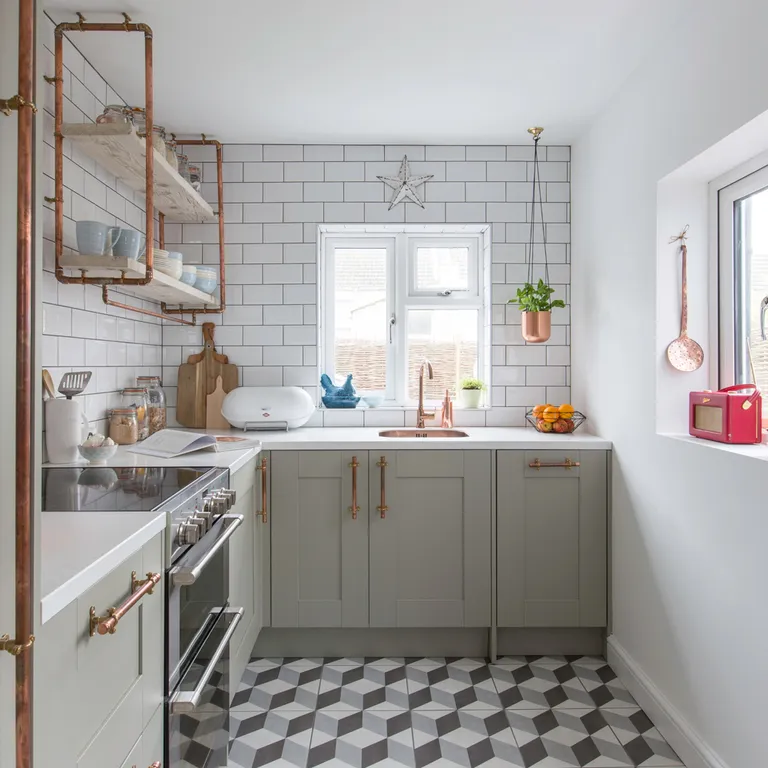 Image credit: Future PLC/ Jonathan Jones When tiling multiple surfaces it’s tempting to mix things up, to add interest – using patterned tiles alongside plain designs. The rule of thumb is to choose one surface to use each style, to help balance the look. Using pattern on the floor in a kitchen will help to anchor the decorating scheme. 16. Use slate to create a splashback Image credit: Oliver Gordon Mimic the exposed-brick look with a tiled slate wall. With its naturally smooth texture and varying shades, from pale grey to dark purple and rich rust, slate is a beautiful choice for walls and splashbacks. Leave your slate tiles ungrouted for added character. 17. Fake it with marble effect tiles Image credit: Mandarin Stone Marble is an intricately beautifully stone, but it can also be very costly, especially if you have a large area that needs tiling. Why not fake the look with a porcelain tile that looks almost identical to real marble? There are many good-quality marble effect tiles on the market, at a price to suit most budgets. 18. Choose a modern bistro-style vibe with metro tiles Image credit: Future PLC/ Dominic Blackmore If you have a large wall to fill in the kitchen, consider creating an entire feature wall of metro tiles. Brick-shaped or Metro-style tiles with a distinctive bevel are a popular choice and provide a retro twist. Choose matt flat or glass brick tiles to create a more contemporary feel. Be sure to choose the right grout. Not only is it practical bonding for durability but it's key to determine whether your pattern stands out or blends in to the overall scheme. It comes in various colours and compounds so do your research. What type of tiles are best for a kitchen?Tiles come in all sorts of materials, so it’s all to easy to look for design over what they’re made of. ‘Both ceramic and porcelain tiles offer a wide range of stylish options, so there is bound to be something that meets your needs,’ advises Jayne Adamson, marketing manager at Verona. ‘In terms of the technicalities, ceramic and porcelain are very hardwearing and both options are sound for use on walls. As the kitchen is prone to mess and moisture, it's best to opt for a tile which is easy to clean.’ Finish should be kept in mind, too. ‘We recommend glazed tiles for kitchen walls and splashbacks,’ says Lee Thornley, founder of Bert & May. ‘As well as being practical, their glossy finish adds a reflective sheen to bring depth and drama to a space.’ What are the backsplash trends for 2022?Splashbacks, or backsplashes, are one of the most common and popular ways to use tiles on kitchen walls. ‘In kitchens, no matter what size, a splashback can have a huge impact,’ says Amanda from CTD Tiles. You can make a statement through colour or through pattern, either way you'll find that using your wall tiles creatively for a splashback is a really simple way to add interest.’ ‘When it comes to trends, we've noticed that bold colour combinations is a firm favourite,’ continues Amanda. ‘Rich greens, bold blues and pastel hues are top ranking colours and all work brilliantly as a backsplash. Another popular look is three dimensional texture, it's a look that adds unexpected depth to a room and it's a completely new exploration for those wanting to touch on a refreshing update in their kitchen.’ Shapes of tiles for splashbacks are also trend-led. ‘Metro tiles will always be the reliable format which homeowners look to use year after year,’ says Kamila Chalfin, Marketing Manager at Tile Giant. ‘Play it safe with a classic stack bond, or style it out with a contemporary herringbone or basket weave layout to turn your splashback into a feature wall of its own.’ What colour tiles are best for a kitchen?While colours should always be down to a combination of personal preference and the lighting and style of your room, there are some colours which naturally work better across kitchen tile ideas than others. ‘Neutral tiles continue to be a popular choice for kitchen walls because they're timeless, classic, and easy to style,’ says Lee from Bert & May. ‘With neutral tiles you can easily to change up the décor in your kitchen as you please without any worry of clashing. Warmer neutral shades, will add the illusion of depth, airiness and light, no matter what size your kitchen is.’ ‘White and grey tiles continue to be popular as well as patterns,’ adds Jayne from Verona. ‘But there's been a huge surge in demand for blue and green tiles, particularly small formats. From tropical turquoise to nautical navy, blues are dark and dramatic, while green shades are on the other end of the spectrum, with pale, sage tones being used to breathe new energy into the kitchen and recharge the space.’ And if you’re not into neutrals? ‘Pastels shades of mint, duck egg blue and dusty pink have been holding strong for a few years now,’ notes Kamila from Tile Giant. ‘These are a great starting point for homeowners who are new to colour, but if you’re bold with your interiors, opt for rich, jewel tones such as emerald and dark blues which reflect natural light. We’re even seeing black tiles become a more popular colour choice within modern kitchens. The post Kitchen tile ideas to add style and personality to your walls appeared first on Ideal Home. |
| Step inside this refurbed 1930s home with a calm but cool colour palette Posted: 26 Jan 2022 04:16 AM PST  When a young family needed to refurbish their newly purchased home they enlisted expert help, and everything flowed from there. After a year spent searching for their ideal house, the now-owners finally found a 1930s detached property quite close to where they were living, in north London. 'It had been lived in and loved by the previous owners for 40 years but seemingly hadn't been updated in that time,' they say. 'It needed some TLC in the form of a top-to-toe refurbishment so we called in XUL Architecture. They have a fantastic reputation in this area and considerable experience of working on similar houses to ours.' In turn, Sebastian Sandler of XUL says that working with owners who were decisive and had a clear idea of what they wanted, helped the project go smoothly. 'They told us that their aesthetic throughout the home was contemporary-traditional, with an interior that felt homely and welcoming yet modern and sophisticated,' he says. The kitchen Image credit: XUL Architecture/Matt Clayton An important part of achieving that feel was enlarging and reconfiguring the building as far as the strict local building regulations would allow in the conservation area. On the ground floor, that meant extending out at the back to create a kitchen extension idea with a large skylight to fill this space with much-needed natural light. The kitchen details Image credit: XUL Architecture/Matt Clayton 'XUL brought more light and space into the kitchen and cleverly linked it with the living/dining area,’ say the owners. The island, painted in Farrow & Ball's Pink Ground, links to soft pinks on the sitting room furniture. Just as XUL have created a sense of flow with light and space, the owners have achieved the same with their interior style. 'This has been an amazing collaboration that has exceeded our expectations,' they say. The stunning greens of the cabinetry add a grounding feel to the pastel island, and link the space with the outdoors. The dining area Image credit: XUL Architecture/Matt Clayton 'What was immediately apparent about this house was that it didn't have the essential amenities of contemporary living,’ says Sebastian. ‘Such as a WC, utility room or, importantly, a kitchen connecting to a dining area.’ The open-plan space Image credit: XUL Architecture/Matt Clayton 'The house didn't have the sense of flow that is vital in a home,’ says Sebastian. ‘The ground floor was a series of unconnected rooms.' To remedy this, sightlines were improved, connecting doorways were introduced along with space-saving pocket doors. There is still a flow of light from one space to another – a quality Sebastian believes is essential in the modern home. 'Natural light has a positive effect on spatial quality, wellbeing, productivity and creativity,' he says. The living room details Image credit: XUL Architecture/Matt Clayton The couple have a one-year-old daughter, so it is very much a family home. A fun, lively feel was therefore essential. So the feature wall idea of the clean-lines of the living room-cum-dining area were pepped up with a modern shade of blue. The sitting room Image credit: XUL Architecture/Matt Clayton Muted but complementary colours were used for the sitting room furniture, giving it a contemporary look with a lot of warmth. The deep blue walls provide a contrast to the rest of the subtle scheme. The bathroom Image credit: XUL Architecture/Matt Clayton The upper floors were also opened up wherever possible. The family bathroom and main bedroom were moved to the loft space to take advantage of the generous ceiling height. The master bedroom Image credit: XUL Architecture/Matt Clayton The main bedroom is the place where the owners feel the look has really come together. 'Ripping out the ceiling and restoring the exposed beams gave the room a feeling of expansiveness,’ they say. ‘Which we enhanced by adding wall panelling and paintwork in a pale green to produce a countryside boutique hotel feel.’ Additional words: Sean O’Connell The post Step inside this refurbed 1930s home with a calm but cool colour palette appeared first on Ideal Home. |
| 10 best sofas: affordable sofas that are big on style Posted: 26 Jan 2022 04:00 AM PST Looking for the best sofas? There are few pieces of furniture that are going to make quite as much impact on our homes as the sofa we choose, or that are likely to be quite as much of an investment, so picking the best sofa for you is an important decision. A sofa is the place we sit down and relax in the evening, gather with friends and family, and spend a good chunk of our everyday lives, so obviously any design we invest in needs to be comfortable. And, as one of the largest pieces of furniture in our living rooms – and an item we’re likely to look at every single day – it also needs to score big on style. Plus, of course, there’s budget to consider. It’s clear that a sofa has to fulfil a lot of different requirements, and that’s where our best sofas round-up is here to help. We’ve pulled together the best sofas on the Ideal Homes radar and highlighted the key factors to consider before making a purchase. Whether you want a spacious corner sofa with room for all the family, a chaise sofa to kick back and relax on, a classic three-seater sofa, or a contemporary two-seater, we’ll help you to narrow down your search. And if you want your sofa to work a little harder, then make sure to check out our guide to the best sofa beds too. Best sofas 2022: the Ideal Home edit1. John Lewis & Partners Draper Large 3 Seater SofaBest three-seater: a comfortable high-backed design that will work with almost any decor
Dimensions: H87 x W202 x D95cm *other sizes available* A modern sofa with a nod to the classic Chesterfield design in its buttoned cushion detail, this is a sofa that will blend easily into a broad range of interiors, helped by the 90+ upholstery options that are on offer. Although, if you opt for the fabric pictured – a nice mid-tone grey with light wood legs – then this sofa can be delivered in as little as 7 days (a rarity in the world of sofa shopping where lead times of 10-12 weeks are the norm). Available in a good range of size options, including a 2, 3, and 4-seater plus a chaise, it’s also a good value option with prices starting from £1449 for the most compact design. And – the important bit, of course – this a really comfortable sofa to sit on. The relatively high back cushions are soft but firm, helped by a high backrest which means you’re not just relying on the back cushions themselves for support as can often be the case. It isn’t a super squishy sofa, but the seat cushions are still comfortable to sit on and offer enough room if you’re a sofa lounger who prefers to curl up rather than sit upright. Overall, we think this is a great all-rounder that manages to tick a lot of boxes at a good price. Buy now: Draper Large 3 Seater Sofa, from £1699, John Lewis & Partners 2. Sofa.com Holly 2 Seat SofaBest two-seater sofa: a compact tall-legged design that’s super comfortable
Dimensions: H87 x W155 x D90cm *other sizes available* If you’re looking for a sofa to fit into a small living room then the Holly is a great option to consider. Although the 155cm width 2-seater sofa is the most compact seating size on offer, the model also comes in a wide choice of larger space-saving options including 2.5, 3 and 4-seater sofas, plus a variety of chaise and corner sofa sizes. Its petite proportions are partly down to the slim armrests that lend the design a contemporary edge, and its ability to make a small room feel more spacious is largely thanks to those tall legs which allow the eye to travel under the sofa and reduce the frame’s bulk to give the impression of more spaciousness. Clever tricks aside, this is also both a stylish and comfortable sofa at a great price point. There are 70+ upholstery options on offer, including some brilliant shades of velvet, and feather-wrapped foam seat cushions, feather back cushions, and a high-backed frame deliver just the right mix of squish and support in our opinion. It’s also a good option if you want to overhaul your entire living room suite, with a coordinating armchair and footstool available alongside that wealth of sofa sizes. What’s not to love? Buy now: Holly 2 Seat Sofa, from £850, Sofa.com 3. MADE Luciano Chaise End Corner SofaBest chaise sofa: a spacious L-shaped sofa with plenty of bounce
Dimensions: H86 x W278 x D154cm If you have the space for it, then in our opinion you’ll likely not regret opting for a chaise or corner sofa – especially in a family living room. Perfect for stretching out and putting your feet up, an L-shaped chaise gives that bit more room for relaxing (although you could add a footstool instead if that offers more versatility). Of course, adding an extra few feet of legroom means you’re going to increase the cost of a sofa, which is why we think this affordable chaise sofa from MADE is a great value option. Upholstery options are limited to just 7 choices, but there are some good fabric selections amongst those, including the versatile Mountain Grey (pictured), plus some attractive leathers if that’s more your style (although they will add on an extra £800 to the price tag). Comfort-wise this chaise sofa doesn’t miss a beat either. We tested the leather version (which is likely to be a little firmer) and the seat cushions were pleasantly soft with a surprising amount of bounce, plus back cushions offered a good level of support. Unlike some chaise sofas you can’t swap the chaise section around on this mode, so just make sure you plan out your room layout before you buy, and lead times can be on the lengthy side, so you may need to be willing to wait to put your feet up. Otherwise, we think this is a great option to get comfortable on. Buy now: Luciano Chaise Corner Sofa, from £1099, MADE 4. Sofa.com Holly Corner SofaBest corner sofa: an affordable corner sofa with a great range of size options
Dimensions: H87 x W266 x D266cm *other sizes available* So good we included it twice, the Holly sofa from Sofa.com features again as our best corner sofa recommendation. All that applies to the 2-seater option applies here too, including comfortable seats, stylish upholstery options and great value starting prices. What makes this design special as a corner sofa is the range of corner configurations available, from a super-compact Extra Small 2-seater corner sofa, through Small and Medium to the Large 6-seater design; all making it easier to tailor a corner solution to your individual space. The tall-legged design also works well to eliminate the heavy bulk that can often come hand in hand with a corner sofa, making a corner solution an easier win in a small to medium-sized living room. Buy now: Holly Corner Sofa, from £1715, Sofa.com 5. Furniture and Choice Enzo Leather SofaBest leather sofa: a contemporary leather sofa that doesn’t break the bank
Durable and easy to clean, there is a lot to be said for a leather sofa, but there’s no denying that leather seating tends to come with a very high price tag, and can sometimes err on the more bachelor pad side of the style equation. However, if you’re looking for an affordable leather sofa, and one that is far more contemporary than classic, then the sleek lines of the Enzo sofa could well fit the bill. It only comes in two colour options – dark grey or light grey – but both are versatile options that work perfectly in a modern home, and with its cushioned fold over arms and headrest combined with slim chrome stiletto legs, the clean-lined design blends minimalism with comfort. There are options of 2 or 3-seater sofa, plus if you are planning a complete living room overhaul then Furniture and Choice offer discounts on buying a set, with the 2 and 3-seater package coming in far less than your average leather settee. Buy now: Enzo Leather Sofa, from £749.99, Furniture and Choice 6. Swyft Model 03 Large 3 Seater SofaBest modular sofa: a versatile sectional sofa that allows multiple configurations
Dimensions: H71 x W254 x D92cm *other sizes available* A modular sofa can make for a really versatile seating solution, with independent sections able to be mixed and matched to create the configuration that best suits your room. A sectional design also makes a good bet if you’re renting or planning on moving house in the near future, as it’s more likely you’ll be able to adapt the seating layout to suit a new home. Swyft’s sofa-in-a-box design is also a boon for apartment dwellers or anyone with tricky access, as the individual sections are delivered in far more easily manouevrable boxes that mean you don’t need to contend with negotiating flights of stairs or narrow hallways with a ready-built full-size sofa. The design is contemporary and that low back won’t be for everyone, but our testers found this a comfortable seat that’s perfect for those who prefer to lounge or lay rather than sit upright. Just bear in mind you will probably need a large room to accommodate this sofa, as although you can add or subtract seating modules to tailor the width to your liking, we think the low-to-the-ground blocky shape tends to suit a large room best. In fact, this design is perfect for an open-plan layout where you can use an L-shape or U-shaped configuration to zone a seating area within a larger space. Buy now: Model 03 Large 3 Seater Sofa, £2385, Swyft 7. Sofa.com Bluebell SofaBest classic sofa: a traditional-style sofa that’s ideal for a period home
Dimensions: H91 x W218 x D106cm *other sizes available* If you have a period property, or want to add some character to a new build, then incorporating furniture with classic proportions can be an easy win. The rolled arms, piped upholstery and turned wooden legs on castor feet means the Bluebell sofa delivers big on just that kind of traditional detail. As one of Sofa.com’s bestselling designs, this sofa also comes with a <b>lot</b> of options. Firstly, there’s the 70+ upholstery fabrics which allow you to keep things classic or go more contemporary with a jot of colour. Then there’s the size options, including 2, 2.5, 3 and 4-seater plus chaise, corner sofa and sofa bed, complemented by the matching armchair and footstool. And lastly, for around £200 more you can opt for any of the straight-backed sofas to be delivered in 4 pieces and assembled in the room of your choice to make tricky access and awkward layouts one less thing to worry about. It makes for a sofa that solves a whole lot of the usual compromises regarding size, colour, fabric and fit. Although… we found the model we tested wasn’t the most comfortable sofa we’ve sat on as the unplumped the seat cushions ended up feeling pretty firm. But, the backrest was soft yet supportive and considering its combination of classic good looks and price, we might well be tempted to add a few extra cushions to compensate for some lack of squish. Buy now: Bluebell sofa, from £1115, Sofa.com 8. French Connection at DFS Zinc 4 Seater SofaBest four-seater sofa: a spacious sofa with a super affordable price tag
Dimensions: H88 x W227 x D93cm *other sizes available* Designed by French Connection in collaboration with DFS, the Zinc sofa comes in a whole host of size options, from compact two-seater to more spacious chaise and corner sofa, and this option – somewhat of a rare breed – the straight-backed four-seater sofa. The design is contemporary, with angled, lozenge-shaped arms that give the sofa a fun, modern feel and there are plenty of playful colours to match. Choose from blush pink, bright yellow, teal and plenty of versatile greys, whether in woven fabric, velvet or leather upholstery. We can vouch for the Zinc’s comfort too. The seat cushions are firm but comfortable and keep their shape well. Whilst the back cushions are squishy which makes it good for lounging on. Our one gripe is that because the back and side cushions aren’t fixed, they do need repositioning regularly, but overall this family-sized sofa is a winner. And that’s before we’ve even talked about the price… From just £899 for a four-seater sofa? That’s definitely a price that’s hard to beat. Buy now: Zinc 4 Seater Sofa, from £899, French Connection at DFS 9. Sorrento 3 Seater Recliner SofaBest recliner sofa: get ready to kick back and relax
Dimensions: H100 x W216 x D92cm *other sizes available* If you’re looking for the ultimate in living room comfort, then a recliner sofa could be the seating for you. The deeply padded Sorrento three-seater sofa offers a high back with cushioned headrest for plenty of seated support, plus a two-stage recliner function to allow you to recline gently, or go full-on horizontal when nap-time strikes; simply pull on the handles on either side of the sofa frame to release the footrest, and then lean back to achieve your desired position. The three-seater sofa offers independent recliners at each end of the sofa with a static middle section, or, if space is limited, there is also a more compact two-seater option on offer, alongside a recliner armchair that’s perfect for finishing the look. And whilst there may only be eleven upholstery options available, there is a good selection of fabric choices amongst them, with six leather options and five neutral fabrics making for a versatile palette that will blend easily into most homes. Buy now: Sorrento 3 Seater Recliner Sofa, from £799.99, Furniture and Choice 10. Swyft Model 04 Sofa BedBest sofa bed: a stylish yet practical sofa-bed-in-a-box
Dimensions: H86 x W208 x D94cm If you want seating that will work a little harder in your home, then opting for a sofa bed can mean you get an extra place to sit plus a versatile sleep solution for overnight guests. However, finding a sofa bed that delivers as both a bed and a sofa – not to mention in terms of style, practicality and budget – can be tricky at best, yet the latest launch from sofa-in-a-box aficionados, Swyft, aims to do just that. The contemporary 3-seater Model 04 sofa bed is certainly stylish, with it’s low profile that wouldn’t look out of place in swish city apartment, and the good news is that when we put it to the test it delivered in terms of practicality too. There are 7 attractive upholstery options on offer, all designed to offer the kind of stain resistance that makes this sofa bed ideal for family living, and as this is a sofa bed where the seat and backrest become the UK double-sized sleeping surface, it gives extra piece of mind that even if you opt for a lighter colour, the sofa isn’t going to show any marks. Even more upholstery protection is offered by the mattress topper which is included with integrated storage unit (a rarity as with most sofa beds you’ll need to buy your own). This also works to up the sleeping surfaces’ comfort levels a notch, as despite the 300 pocket-sprung foam the sleeping area does remain quite firm. As long as you don’t mind sacrificing some squish, then we think this option certainly looks good enough to use as your everyday seating in the living room, but we think it really comes into its own as a versatile spare bedroom or home office guest solution – doing away with the need for a static guest bed and freeing up more of your for everyday enjoyment. Buy now: Model 04 Sofa Bed, £1995, Swyft How to choose the best sofa for your roomSize Firstly, how many people your sofa needs to seat? If you can, opt for one a little bit larger than the maximum capacity to make things less of a squeeze. However, it’s also important to keep your sofa in proportion to the room to stop things from feeling cramped or your sofa getting lost in a larger space. Measure out where the sofa will go in your room – including the sofa depth – to make sure there is plenty of space to walk around it. Check heights to make sure it fits under windowsills or existing wall furniture, and if it isn’t flat-packed then measure doors and awkward hallway angles carefully to ensure you will be able to get it into the room. Layout A sofa can be a really useful zoning tool in an open-plan layout, helping to create designated areas for dining or relaxing within a larger space. Chaise sofas, corner sofas or modular sofas in an L-shaped or U-shaped layout can be particularly useful here, or – if you have the space – you might want to switch up the usual layout of the sofa facing the fire or TV, and have two similar-sized sofas facing each other to create a space that works better for socialising and entertaining. If you need some layout ideas then make sure to check out our living room and small living room ideas pages. How to choose the most comfortable sofa:Style To our mind, sofa sitters fall into two main camps; those who prefer to sit up straight with good back support – in which case you might prefer a shallower seat depth with a higher backrest that means you can keep feet planted on the floor and your back aligned – or, those who instantly curl up or recline to lounge – in which case deep squishy seats and plenty of seat depth to add cushions could suit you better. A chaise sofa can combine the best of both worlds and keep everyone happy, whilst a corner sofa can be a great option for family living. Cushioning Most sofas either have foam-filled or feather cushions; foam cushions will bounce back into shape more quickly but generally provide a seat with more resistance, whilst feather cushions create a deeper cushion to sink into but will likely need plumping regularly, and when they’re not plumped the feathers can become compacted and feel quite hard. Many manufacturers have now combined the best of both worlds by wrapping resilient foam cushions in plumptious feather outers. How to choose a sofa style you’ll love:Upholstery Once you’ve chosen your favourite sofa shape, then it’s time to choose colour and fabric. Most sofa retailers offer models in a range of fabrics, generally including more affordable polyester and cotton mixes (which often have better stain resistance so are useful for homes with young families), and more expensive linens, velvets, and leathers. Take advantage of fabric samples to view colours and textures in your own home, as lighting can often look very different to that in showrooms or online representations, and bear in mind that the more luxurious fabrics are also likely to increase the sofa price quite considerably. As much as you might love pale colours, for family living a darker or marl shade is likely to prove more stress-free, helping to disguise any mishaps! Legs A sofa’s legs can transform the look quite dramatically. Tall legs will lift the bulk of the sofa away from the floor and can be a good option for smaller rooms where being able to see more of the floor gives a feeling of spaciousness. A sofa that sits directly onto the floor can feel bulkier so is best for larger rooms – although this style also has the bonus of stopping dust-balls and toys from rolling under it! Shapely, curved legs add a classic touch, whereas straighter clean-lined legs give a more modern feel. Some sofa models may offer a choice of leg finish as well as upholstery – if you already have wooden furniture in your living room, try to tie in any wooden leg finishes to keep tones coordinating. Lead time If you’re choosing from made-to-order upholstery options, then it’s important to bear in mind that there’s likely to be a lead time whilst your sofa is built. This can be anywhere from 6 – 14 weeks and will differ by retailer and the time of year you’re ordering. October and November are generally when sofa demand is highest ahead of the festive entertaining season, but you’ll find some top tips for shopping at this time of year in our guide to where to buy a sofa before Christmas. Looking for sofa deals?Nothing beats a bargain, especially when it comes to finding a great deal on a big-ticket item like a sofa or sofa bed. Make sure you’ve found the best prices on your dream living room seating by checking out our sofa deals page for all the latest sofa and seating sales. The post 10 best sofas: affordable sofas that are big on style appeared first on Ideal Home. |
| Thatched roof insurance explained Posted: 26 Jan 2022 03:30 AM PST Wondering if you need thatched roof insurance? Thatched homes may be an icon of the British countryside but they are more expensive to insure than other types of home because of the extra risks involved. Thatched roofs are also more costly to replace than standard tile or slate roofs so it's essential to have the right home insurance in case disaster strikes. Most mainstream insurers don't cover homes with thatched roofs so you'll usually need to go to a specialist insurer. One exception is Admiral, which offers cover for homes with all types of roof. Rural insurer NFU Mutual is another well-known name that insures thatched homes. What is thatched roof insurance? Image credit: Future PLC/ Colin Poole If you own your home you'll need buildings insurance to cover any damage to the structure of your property from events such as fire, a storm or vandalism as it could cost tens or even hundreds of thousands of pounds to repair or rebuild your home if it's destroyed. For a thatched home you'll need a specialist policy that will cover your entire property, including the roof. 'The main risk is fire for thatch, which would damage the roof and the rest of the property, hence you'd insure the whole property on a single policy’ explains David Fowkes, head of household underwriting at Admiral. A thatched roof isn't necessarily more likely to catch fire than a conventional one but if it does it will be difficult to control and could completely destroy your home. Other risks are wildlife, such as birds, mice and rats, nesting in your roof and damaging the thatch. You may also need specialist contents insurance. Getting a combined buildings and contents insurance policy could be cheaper than buying them separately. What conditions apply to thatched roof insurance?An insurer will want to reduce the risk involved by applying conditions that will make it less likely that you'll need to claim. You'll be expected to take steps to protect your property. 'Properly cared for, thatched roofs can last for more than half a century but thatched homeowners should take special care to maintain their property to protect their building, contents and loved ones,' says Phil Cooper, propositions manager at NFU Mutual. 'That means fitting fire safety equipment like fire extinguishers, fire blankets and smoke alarms, and regularly having the thatch, chimney and electrics checked by skilled tradespeople.'  Image credit: Future PLC/ Colin Poole Some of the conditions of NFU Mutual's policy are:
To reduce the risk of fire you may also not be able to use barbecues or fire pits, or have bonfires, within a certain distance of your home. Some policies may exclude the use of wood-burning stoves. There may be conditions about how often chimneys are inspected and swept, which could be once or twice a year. If you don't comply with the conditions it may invalidate your insurance, which means you won't be able to claim if you need to. You'll have to show proof that you have complied, such as by showing inspection reports. How to get the best thatched roof insuranceGetting the cheapest policy shouldn't be your only consideration for roof insurance. Make sure it covers everything you need it to and that you're comfortable with the cover levels and exclusions, which may be different than for homes with standard roofs. You'll need to accurately calculate the rebuild cost of your home to get enough cover while not paying for more than you actually need. This is the cost of rebuilding your home from scratch if it's destroyed, not its market value. It may be higher for a thatched home than for other types because of the specialist skills and materials, as well as the extra time, needed to restore it to its previous state. The rebuild cost will be shown on your mortgage valuation If you've recently bought your home with a mortgage. Alternatively, consult a surveyor. If you live in a newer thatched home built to the Dorset Model – a set of fire protection standards for thatched properties – you're likely to get a discount on your insurance. It's a good idea to speak to an insurance broker to find the best deal. 'A broker will know which insurers cover thatched roofs and will make sure your property is suitably insured,' says Graeme Trudgill, executive director of the British Insurance Brokers' Association (BIBA). You can find one by visiting the BIBA website or calling 0370 950 1790. The post Thatched roof insurance explained appeared first on Ideal Home. |


| You are subscribed to email updates from Ideal Home. To stop receiving these emails, you may unsubscribe now. | Email delivery powered by Google |
| Google, 1600 Amphitheatre Parkway, Mountain View, CA 94043, United States | |


No comments:
Post a Comment